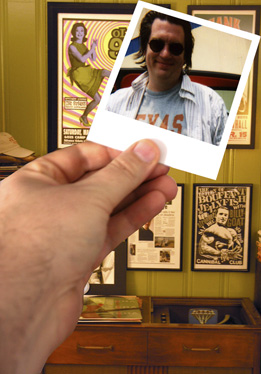
Another photo I took during my Magnolia Street jaunt. It may be immodest to say, but I love this picture.
Saturday, March 25, 2006
Alive

Donald Judd Auction Scheduled
Donald Judd’s children work hard to preserve their father’s legacy.
On May 9 the Donald Judd Foundation, established after Judd's death at 66, in 1994, will put 35 sculptures up for sale at Christie's in New York, in an effort to create a $20 million endowment for the support of its properties in New York and Marfa, where Judd owned 3 ranches and 15 buildings.
Friday, March 24, 2006
Update on the Kinkster
A thoughtful write-up on Kinky Friedman inthe Dallas Morning News (registration required).
255-Year-Old Tortoise ... Dead
A 255-year-old giant tortoise named Adwaitya died at the Calcutta Zoo on Wednesday. The animal had been brought to India from the Seychelles Islands in the mid-18th century as a gift to the British colonial ruler Robert Clive.
What to do now? Make one big, nasty bowl of turtle soup. Yum.

Thursday, March 23, 2006
Neko Case Esta Bueno

Neko Case. Is there anything more to say? Her voice is amazing, clear and haunting. Her new album, Fox Confessor Brings Flood is my album of the year pick. But, my, she has a little bitterness toward her parents. But don't we all.
Must I Paint You A Picture?
 I love me some Billy Bragg and always have since the 80s. There's an interesting interview with him on the Onion's AV Club. Couple of interesting things about it.
Says Billy: "I think the politics that we had in the 1980s in America and in the UK were a lot more ideological than they are now. Reaganomics and the essence of what Margaret Thatcher was trying to do was a lot more aimed at pushing back at what had been achieved in the 1960s." Wow. I remember the 80s, too, and I think this is most poisonous political climate in my memory. Not only are there many in the U.S. interested in undoing the Sixties, they want to undo the New Deal. And they're doing it. That is much more frightening.
However, one thing he said that I completely agree with:
"One thing that's always impressed me about America is your ability to do things when you set your mind to it, even if it is something fucked-up like invading Iraq. You know, you guys logistically are right up there. None of us have got that capacity for moving shit from A to B. It's very powerful. And I would like America per se really to get back in touch with what you Americans refer to as "barn-raising." You know what I'm talking about? When someone in a community wants to build a barn or a house, everybody in the community gets together and spends an entire weekend to help the person to raise the A-frame of their house or their barn. That ability to go out and help people.
"You know, if everyone in the Middle East who met an American met one who had come to help them, rather than an American armed to the teeth who had come to police them, I think we could begin to move away from the situation we've found ourselves in. There's a great film to be made, or maybe a book to be written, called Go Home, Yankee, And Take Me With You. So many people out there look to the United States as a place of great opportunity. And I think that maybe your manifest destiny is to help people rather than to hinder people. I would like to see the American people live up to that."
Monday, March 20, 2006
Readymade Art

I love old signs. I look at them as little pieces of readymade art. Here's one of my local favorites, across from Benito's on Magnolia.
Another Award
My friend Johnny D. Boggs is my hero. He's a guy who follwed his dreams and has had things work out nicely. He quit his day job wrestling with the elements of style in daily newspapering and became an award-winning writer of western fiction. He just won his second Spur Award this weekend for his book, Camp Ford. Check him out and buy a book.
Friday, March 03, 2006
A Picture of Jim
I like taking pictures of people painted on walls. This is Jim. I snapped this back in January down on Magnolia.
Thursday, March 02, 2006
Not Staying On Top of Things
Today is Texas Independence Day, which I usually celebrate by not celebrating at all. It's usually something along the lines of, "Oh, today is March 2. Texas Independence Day."
Anyway, I wanted to write about Black History Month, not Texas Independence Day, so bear with me. My daughter read the following poem from Robert Hayden poem "Frederick Douglass" at her school assembly. She's a very articulate, confident reader for an 8-year-old, which is why they asked a blonde-haired white girl to read a poem for Black History Month. And this poem is amazing:
When it is finally ours, this freedom, this liberty, this beautiful
and terrible thing, needful to man as air,
usable as earth; when it belongs at last to all,
when it is truly instinct, brain matter, diastole, systole,
reflex action; when it is finally won; when it is more
than the gaudy mumbo jumbo of politicians:
this man, this Douglass, this former slave, this Negro
beaten to his knees, exiled, visioning a world
where none is lonely, none hunted, alien,
this man, superb in love and logic, this man
shall be remembered. Oh, not with statues’ rhetoric,
not with legends and poems and wreaths of bronze alone,
but with the lives grown out of his life, the lives
fleshing his dream of the beautiful, needful thing.
For a thoughtful examination of this poem, read the Say Something Wonderful Blog.
Monday, February 20, 2006
Would You Let This Man Run Your State?

Although I think one of the biggest problems with the blogosphere is the tendency for people on the left and the right to spew forth about their ideology when in reality they are merely regurgitating the talking points set out by the party or some think tank. Hey, I’ve done it, too. But I’m a lot more interested in a person’s authentic inner or artistic life rather than how effectively a person toe’s the party line. I think that is where the medium becomes an art form.
With that in mind, let’s talk politics.
I’m supporting Kinky Friedman in his run for the governor’s mansion because I think he has a point: people get the kind of government they deserve. Something is seriously, spiritually wrong in Texas and it is up to the people to fix it.
I know that the problem isn’t just Texas. Special interests and their big money have a stranglehold on Washington, D.C., too. But if you live in Texas, you can’t do anything about D.C. This is a one-party state, the reddest of the red. It is going to take someone to seriously rock the boat in Washington and it ain’t coming from here.
But we can do something about it here in Texas. The Kinkster is an authentic, independent voice who is as fed up as I am and is prepared to do something about it. To paraphrase his talking points:
Education
An educated workforce and top-notch schools are essential to keeping our state attractive to new business, but we're failing the test.Texas has the 8th largest economy in the world, but we're 1st in drop-out rates and 49th in education spending in the country. Teachers' salaries in Texas are over $6,000 below the national average. This lack of respect for the people who do our state's most important job must stop. As governor, Kinky will work to make sure that teachers are paid what they're worth. Period. The TAKS test and its predecessor, TAAS, were invented essentially to make legislators look good on education. But studies show that rigid enforcement of standardized test scores doesn't help kids learn or make teachers more effective. Teach to the test and kids will learn the test—but not much else.
Healthcare
Texas ranks rock-bottom in providing for the basic needs of its youngest and poorest residents. More than one fifth of Texas children have no health insurance at all. In 2003, Texas legislators slashed the Children's Health Insurance Program, pulling the rug out from under 170,000 kids. Not only did this put more of our children at risk, it ended up costing the state tens of thousands of health care jobs and $16 billion in lost productivity. Kinky believes this is reckless and short-sighted—no way to invest in the future of Texas. We're a state that prides itself on friendliness and responsibility, but the message we're sending our kids is that if you're going to be born poor, you'd better not be born in Texas.
Renewable Energy
It's time for Texas to reclaim bragging rights as an energy icon. As governor, Kinky will accomplish that by encouraging investment and innovation in new methods of electricity generation and new fuels like biodiesel.
Think these are fringe technologies? Think again. Wind power plants, solar power arrays, and landfill gas capture systems are already in operation across Texas in cities from Fort Stockton to Fort Worth. Texas has been called "the Saudi Arabia of renewable energy," and firms from TXU to Kyocera are already clamoring for a piece of the action.Despite our staggering potential, only 0.7% of Texas' energy needs come from renewable sources. That puts us 51st in the nation, behind even Washington D.C. Biodiesel—it's good enough for Willie Nelson’s tour bus, and the city of Denton is using it to fuel their entire fleet of diesel trucks. Biodiesel is fuel you can grow. That's good for farmers, good for the air, good for the Texas energy industry and good for Texans. With biodiesel, everybody wins but OPEC.
OK, that’s the party line right there. I’ve never worked on a political campaign before, but I am now. If you live in Texas and are looking to vote for the Kinkster, here’s what you need to do:
Thanks for letting me on the soapbox. Back to your regularly-scheduled noodlings.
Saturday, February 18, 2006
Flatiron Building
I haven't posted a photo in a while so I thought I would post a picture of Fort Worth's Flatiron Building, the only true flatiron building in Texas.
Modeled after Daniel H. Burnham's 1902 Flatiron Building in New York City, Fort Worth physician Bacon Saunders commissioned Fort Worth architects Sanguinet and Staats to design and build the seven-story building in 1907. Bacon later had his offices in thew building. This building has been on the National Register of Historic Places since 1971. It became a Recorded Texas Historic Landmark in 1970 and a City of Fort Worth Landmark in 1994. Although it has been unoccupied for several decades, it has recently been remodeled and restored.
Friday, February 17, 2006
Deconstructing Stillman
I love the movies of Whit Stillman because the characters seem to exude this earnestness that used to be sort of a stereotypical American trait but now seems so foreign and charming.
Interesting thing about Stilman – other than the fact that he hasn’t made a movie in eight years – is that evidently conservatives love his movies (according to this Slate article) because "Stillman's films insist that there were (and are) true virtues in this class and its ideals."
Hadn’t really thought that deeply about them. I need to go back and watch Metropolitan, which I loved when it came out in 1990 (but there were a lot of things that I loved in 1990 that haven’t aged that well).
What I do remember was that the film sort of lamented the end of the upper classes, That sort of ennui was rampant then. I remember the novel Generation X by Douglas Coupland had that same sense of that everything was downhill from here, we’ll be the first generation not to do as well as our parents, etc. And a funny thing happened … actually lots of funny things. The Internet, the Stock Boom, 9-11 and so on. Now here we are in 2006 and the world is a very, very different looking place.
Point is maybe Stillman’s movies won’t make the jump. But their sweetness and the feeling that they are like a New Yorker cartoon come to life may save them. We’ll see.
Of course, what really made Stillman's films was Chris Eigeman, who was always the jerk you liked in spite of yourself. He's reason enough to go back and watch all of those films again.
Saturday, February 11, 2006
Doing Indefinable Service to Mankind
Just finished Texas Literary Outlaws by Steven L. Davis, a look at how a small group of writers transformed Texas literature and the state’s vision of itself.
The nucleus of this group, I’m proud to say, enjoyed its formative years in Fort Worth. Dan Jenkins, Bud Shrake and Gary Cartwright all came of age in the sports department of the old Fort Worth Press under the tutelage of legendary sportswriter Blackie Sherrod. As an old Fort Worth sportsguy myself, I know their presence was still a powerful one even in the 1990s when I was there.
Although they are probably better know for their gonzo antics fueled by booze and pills, these guys were serious about the words. Sherrod could be a stern taskmaster gave them a strong foundation on which to build their writing. His mantra was this: hook’em with a strong lead, adopt a distinct point of view and hammer it home with a strong angle. That was the Fort Worth School of journalism.
Sherrod was an old-school, disciplined, hard-ass sports editor. But he also valued the craft of writing. He insisted that his reporter read and discuss literary journalists like Damon Runyon and Mark Twain. They dissected each other’s writing.
Sherrod believed that the games themselves were only of marginal importance. Years later, he wrote in his Dallas Morning News column that he didn’t believe that quarterbacks and shortstops were real heroes – real heroes were guys who could land a torpedo bomber on the pitching deck of a aircraft carrier. His experiences in World War II gave him a perspective – and perhaps a cynicism – that was a valuable component in his work and once that he passed on to those he worked with.
His writers learned that lesson well and throughout their careers, Jenkins, Shrake and Cartwright used sports as a departure point to discuss topics that were of far more interest to them. That’s a lot different than the attitudes of sportswriters today. ESPN has poisoned the minds of a generation of sports journalists. Today, everyone wants to be a personality – it’s all about the pose and the blather. The Sportscenterization of America has mangled the craft of sportswriting. No one cares about the words anymore, all they care about is their closeup.
One ugly truth that these guys dealt with then that hasn’t changed today is the current of anti-intellectualism and conservatism for which Texas is unfortunately famous. This book really helped me place these attitudes on a continuum and see how some things really don’t change that much. There have always been Rick Perrys.
Like their friends and colleagues Larry L. King and Billie Lee Brammer, their exploration of social, racial, sexual, musical, existential and pharmaceutical issues went against the grain. Spiritually, they had more in common with the Beat Generation than they did their peers in the newsrooms where they worked. They even coined a name for their spiritual fellow travelers – Mad Dogs, Inc. “Doing Indefinable Service to Mankind” was their tagline and their universe included Willie Nelson, Jerry Jeff Walker, and Ann Richards.
The Mad Dogs were aware that something was different in postwar America and they were desperate to define it and discuss it. Objectivity didn’t exist; they put themselves in their stories. They may have tried to stay aloof, but they were there. They were involved.
But this journey often led them away from Texas. However, even when they left Texas, Texas didn’t leave them. They came back to these themes and topics throughout their careers.
Brammer’s novel The Gay Place is hailed as “Texas’ first urban novel” and while that is certainly true, it’s also a powerful exploration of not-so-young people grappling with mortality, lost love and broken dreams. It’s a work about existential dread as much as it is about politics and Brammer describes that ennui better than anyone else I’ve read recently.
The same could be said for another peripheral character in this book, another Fort Worth resident named Jay Milner. His memoir, Confessions of a Mad Dog, hits on all of these same topics and is a valuable supplement to Davis’ work.
I’m heartened by the perseverance of these guys as writers. Even when it didn’t seem that anyone wanted to read their work, they kept after it – they might have made good bloggers. It wasn’t easy making ends meet with families to feed and day jobs to hold down, but they still managed to make time for their work. And lots of drugs, alcohol and misbehavior which didn’t make family, work and writing any easier, but it sure seemed like fun anyway. Their search for meaning and purpose wasn’t an easy one either.
How will history judge these guys is the last question this book asks. When their work is separated from their personality, will it endure? That answer seems to be yes for now, if only because they were such keen social observers and chroniclers who record that moment when Texas really changed.
Thursday, February 09, 2006
Whitley Benefit
My wife and I saw Chris Whitley play at The Caravan of Dreams in 1992 or 93 and his music was a significant part of our courtship. He was an immensely talented and troubled soul who died too young. Benefit concerts will be held in NYC, Houston and Austin over the next few weeks to build a trust fund for his young daughter.
Living the Dream
Matthew McConaughey is doing exactly what I would do in his position – using his fame and fortune to hang out with the Texas Longhorns. That and shooting tequila with Oprah. And playing bongos naked while baked. I could go on but I think I've said enough.
Cabaret Royale
Anyone woman willing to appear pregnant and nude in a major motion picture qualifies as a confident and daring performer. That’s Ute Lemper. According to The New York Times, her cabaret show is pretty dynamite. Wish I could make it up there to see it.
All That and a Bag of Chips
Tabloid journalism has its moments. Sure it’s sensational and shallow. But where else can you find stories like this: workers fired from potato-chip factory get a 50¢ bag of the company's chips as severance.
Wednesday, February 08, 2006
Do Justice and Let the Skies Fall
Just finished Christopher Hitchens’ Letters to a Young Contrarian, and I feel motivated and repelled by his philosophy at the same time. The best example of his ethos follows:
“So I have no peroration or clarion note on which to close. Beware the irrational, no matter how seductive. Shun the transcendent and all who invite you to subordinate or annihilate yourself. Distrust compassion; prefer dignity for yourself and others. Don’t be afraid to be thought arrogant or selfish. Picture all experts as if they were mammals. Never be a spectator of unfairness or stupidity. Seek out argument and disputation for their own sake; the grave will provide plenty of time for silence. Suspect your own motives and all excuses. Do not live for others any more than you would expect them to live for you. (p. 140)
Hitchens believes in rational, empirical thought. He’s a cogent thinker and lucid writer. He takes no quarter and expects none. He’s a humanist and believes in the dignity of humankind. Liars, charlatans, dictators and anyone of a religious bent are apt to find themselves in his crosshairs.
But to me, the major flaw in his worldview his absence of the transcendent, the notion that there is something larger than ourselves that tie us together. There’s no God in his universe. He admires Dietrich Bonhoffer and Martin Luther King Jr., but doesn’t understand or appreciate how their faith sustained them through their dark moments. And the Dalai Lama – don’t even get him started.
A lesser flaw is that he assumes we live in a rational world. After 9-11, Abu Gharib, Hurricane Katrina and – how many seasons of Survivor and American Idol? – forgive me, but I can’t make that assumption.
Behind his veneer of cynicism, he is an idealist and a bit of a utopian, but I guess you must be in order to be a contrarian. Case in point: he’s especially wary of tribalism and any setting apart of a group for national, racial, religious, political or other reasons because it can “make people accept lethal and stupid conditions” (p. 104).
I agree with him to a point. As much as I wish everyone could see themselves as citizens of the world, people are going to view the world through the prism of their own experience, and where you are from, how you are raised and the God you pray to (or don’t pray to) will influence that for most people. People choose sides.
And even Hitchens understands this, but believes that people should choose their sides based on conscience rather than tribe:
”Dante was a sectarian and a mystic but he was right to reserve one of the fieriest corners of his inferno for those who, in time of moral crisis, try to stay neutral.”
I agree with this to the hilt. But I am also not naïve enough to think that people will always choose the moral high ground over allegiance to the group. We see this today in the moral ambivalence that many Americans have over the use of torture as an instrument of national security. If it keeps us safe, the reasoning goes, maybe a little torture isn’t so bad.
His world is not one of grays – it’s black and white. “The truth cannot lie, but if it could it would not lie somewhere in between. On some grave questions, there is no difference to be split; one does not look for a synthesis between verity and falsehood….(p. 20)” Me, I’m all about the gray. He’s right, on some questions there is no middle ground. But I think his list of questions is much longer than mine.
I admire Hitchens for his thinking, his writing and his moral compass. Taking a page out of Rilke’s book, he recognizes the value of going inside oneself on voyages of self-discovery:
”I do warn you that if you feel capable of going into internal exile and living against the stream, you can expect some dark nights of – all right – the soul. But then to undertake this and to then seek external or invisible aid would be to miss the point. A degree of solitude and resignation is necessary to begin with. Some people can’t bear solitude, let alone the idea that the heavens are empty and that we do not even succeed in troubling their deafness with our bootless cries.” (p. 66)
But where I am truly heartened by his example is when explains that being a contrarian is something you are, not something you do. I deal with this impulse in my own life – I see things a certain way and I’m not afraid to share my opinions. I can’t be any other way. It has cost me jobs, but I have never been one to pretend the emperor has no clothes.
But that’s OK, Hitchens says. Pick a side, dig in, arm yourself with facts and fight like hell. As the Romans would say, “Do justice and let the skies fall.”
Subscribe to:
Posts (Atom)