Showing posts with label Walker Evans. Show all posts

Wednesday, August 06, 2008

Let Us Now Praise Famous Men

William Faulkner once wrote, “The past is never dead. It's not even past.”

True dat. I can still remember sitting in bar drinking Guinness and talking with PeteG about the magnificence of Joe Strummer a year ago, or walking down the midway at the State Fair a decade ago with my year-old daughter perched on my shoulders or the smell of a spring evening on the first night I ever kissed my wife. To me, it seems like these things happened just this morning.

And sometimes our past and our present and our future can all become one, all tangled up in memory and possibility. And sometimes, as the great writer Tim O’Brien reminds us, sometimes the past can even save us.

I bought a book at Taylor’s Bookstore in Arlington, Texas in 1991. It was and is called “Write to the Point.” It’s a book about writing by my old professor from the University of Texas, Bill Stott.

Bill was one of my favorite professors at UT. I took a class from him in the spring of 1989 called the History of Photography that he taught with J.B. Colson, a professor of photography in the College of Communication.

To say that the class was a transcendent experience would be an understatement – I don’t believe you can learn about the genius of Walker Evans for the first time and not feel like the world has somehow changed. I spent that summer reading “Let Us Now Praise Famous Men” late into the night in a tiny yellow house on 30th Street, smoking Luckies and wondering if I could ever write something that great.

It wasn’t the last experience I had with Bill. I spent more than a few hours talking about Evans and James Agee and documentary expression during his office hours when I was still suffering from the delusion that I would go the grad school. My last semester in Austin, I took one last writing class from Bill and wrote some of the best stuff I ever wrote in college.

The real highlight for me was the way he would grade papers. Students would turn in their assignments in a 9x12 manila envelope with a typewritten paper and a blank audio cassette enclosed. Bill would read your paper aloud, grade it and return it to you. Sound terrifying? It was anything but. Not only do I treasure those memories, I still have the tapes.

That fall, I bought “Write to the Point,” read about five pages, then put it on a shelf.

In spite of my disregard for Bill’s book, I managed to make a career using words, first with eight years as a newspaperman at the Fort Worth Star-Telegram, then another few years working for Internet startups before spending almost seven years working as a corporate communications consultant for some of the biggest companies in Texas. Then one day in December of last year, I gave the middle finger to my boss after she said I could neither write nor edit.

As liberating as it can be to lay out a giant “fuck you” to someone who doubts your ability, I must confess that this prompted a bit of an existential crisis. I mean, could this person be right?

So I grabbed my copy of “Write to the Point” off the shelf. About half way through this magnificent book, I had an epiphany. Not only could I write, but realized that I learned to write in large part because Bill Stott showed me the way.

As I read, I dog-eared pages, underlined key passages, starred items and wrote things in the margins. Among them:

  • There is no “perfect way” to writing.

  • Say what you mean as plainly as you can.

  • Poets are the unacknowledged legislators of the world.

  • Context matters enormously.

  • Is it alright to end a sentence with a preposition? Yes.

  • Try the first words that come to mind because they are the most natural.

  • Style has no necessary relation to an author’s character.

  • Writing a bad sentence is natural. All it takes to right a competent sentence is patience and practice.

  • Write as you talk.

  • To read these words were an affirmation and a motivation. Ever since, writing has seemed somehow different – easier and effortless. And most days, I feel pretty good about my writing, too. Some people are even kind enough to tell me that they enjoy my writing – including my new boss.

    I’m grateful to Bill Stott for his teaching and his patience 20 years ago. And I’m grateful that he wrote a book like “Write to the Point” that was able to say the things I need to hear when I needed to hear them.

    When I read the other day about his struggle with cancer, it was like a dagger in the heart. How could something like this happen to someone who is so alive in my memory?

    In part, that’s what got me off my ass to write this post. I wrote last year after the passing of another great UT professor, Kurth Sprague, that if I have learned to write at all, then Kurth and Bill Stott and F.J. Schaack were certainly, in part, responsible. I stand behind my previous statement.

    But one last thing I underlined in Bill’s book I believe is worth mentioning:

    “People think I can teach them style. What stuff it is. Have something to say and say it as plainly as you can. That is the only secret of style.”

    So be it. Bill, you were there for me in 1989, and you were there for me again in 2008. You made a difference, and my life is better for having you as my teacher.

    Thank you.

    Sunday, June 15, 2008

    "A Death in the Family" Revisited

    We are talking now of summer evenings in Knoxville, Tennessee in the time that I lived there so successfully disguised to myself as a child.

    So begins one of my favorite book, "A Death in the Family," by James Agee, winner of the Pulitzer Prize for fiction in 1958. Agee was a tortured genius haunted by the death of his father when James was 6, and this novel, published posthumously after his death of a heart attack at age 45 in 1955, is the work of a writer in peak form.

    Or so I thought. I read today in The New York Times of a "restoration" of Agee's work to it's original form.

    When Agee died, he left a hand scribbled manuscript of a novel that was almost finished. The handwriting was "so crabbed that psychics should have been called in to decode it." David McDowell, Agee’s protégé and literary executor, cobbled together the version of the book that is known and loved today, a lyrical autobiographical account of Agee’s first six and a half years, ending with the death of his beloved father in a car crash.

    Scholar Michael A. Lofaro spent years shuffling through the original manuscript to create "A Death in the Family: A Restoration of the Author’s Text," by "tracking down the variants, squinting at Agee’s gnarled handwriting, deciphering illegibilities, comparing drafts, speculating, emendating, annotating — and when it comes to his predecessor McDowell’s version, lacerating."


    But was Lofaro able to improve on the original? Will Blythe, writing for The Times says yes:

    "At last we have 'A Death in the Family' that appears closer to the author’s original intention. This tidying is good in its own right, but the main reason to celebrate the publication of this version is that it serves as a fresh reminder of the wondrous nature of Agee’s prose — unabashedly poetic, sacramental in its embrace of reality, and rhythmical as rain on a Tennessee tin roof."

    I would like to heartily add an "amen" to the previous statement. Even without the novel, Agee would have been remembered for any of his many accomplishments. He was an accomplished poet and a well-regarded journalist who worked for Fortune and time Time in the 1930s. He may be best remembered for his collaboration with the great photographer Walker Evans on their book about the plight of Southern sharecroppers, "Let Us Now Praise Famous Men," but he is also considered the father of American film criticism, which he defined in his book, "Agee on Film." And, if that wasn't enough, he was the credited screenwriter on two classic films, "The African Queen" and "The Night of the Hunter."

    I can't wait to read the new version of this old favorite. If you haven't spent time with Agee, seek out his work at the bookstore or library. Or even spend a moment with this overview from The New Yorker. He is an American original worth remembering.

    Friday, June 22, 2007

    Oh, The Humanities!

    The Smithsonsian may be America's Attic, but the Harry Ransom Humanities Research Center at the University of Texas is America's crazy uncle with obsessive-compulsive disorder and a fat wallet. It's got a Gutenberg Bible (ca. 1455), the First Photograph (ca. 1826), film archives of David O. Selznick and Robert De Niro, paintings by Frida Kahlo and Diego Rivera, and major manuscript collections of James Joyce, Ernest Hemingway, T. S. Eliot, D. H. Lawrence, Isaac Bashevis Singer, Tennessee Williams, and Norman Mailer. It's even got Dorothy's ruby slippers from The Wizard of Oz. The overview of the place in the most recent The New Yorker had me waxing nostalgic a little.

    I've got a soft spot for the place because I used to hang there back in my UT days when I was suffering under delusion that a life in academia would be beneficial. Under the influence of Bill Stott's class on Documentary Expression, I spent many hours going through the James Agee Collection researching Agee and Walker Evans and their book Let Us Now Praise Famous Men. Kurth Sprague also gave me a private tour of the Tom Lea Collection. Although the U gets some knocks for being an overwhelming environment that doesn't care about undergrads, I always found lots of great academic opportunities and people willing to nurture your intellectual curiousity if you made the effort.

    That said, the HRC gets some knocks because gathering this trove of stuff means throwing down some serious coin. That has some regarding the HRC as a bunch of rich Texans with fat wallets and no appreciation for the significance of the work they are buying. That's selling the HRC a little short. My understanding is they do a great job archiving this material for future generations and making it available to the academics of today. Besides -- to paraphrase Ross Perot -- if God didn't want all that stuff here, he wouldn't have given Texans so damn much money!

    Still others wonder "What are Arthur Conan Doyle's Undershirts Doing in Texas?" Or put another way: why would anyone pay good money for some of that shit? Yeah, maybe they don't need the old sandwich found in one of Isaac Singer's boxes, but you never know what is going to provide the "Rosebud Moment," the seemingly unimportant object that is actually the Rosetta Stone for the secrets and meaning of person's life.

    Thanks to Emphemera for reminding me to get off my duff and write this.

    Monday, April 03, 2006

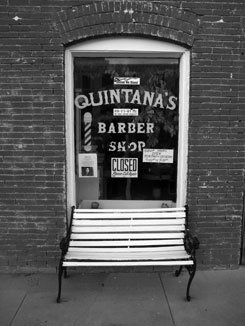
    Walker Evans Wannabe


    I'm giving it my best shot here. I took this in Marfa last summer.

    Wednesday, December 28, 2005

    Alabama modern

    Yes, I am one of those people who gets all their news from the New York Times. Actually not all of it. Just most of it. The rest comes from NPR and the Daily Show.

    Here's what I found today. Evidently, Hale County in Alabama -- where James Agee and Walker Evans chronicled the plight of Depression-era sharecroppers in their classic Let Us Know Praise Famous Men is now a hotbed of modern architecture thanks to some help from a Auburn University program.

    It's nice to see modern architecture, which was meant to offer decent, affordable housing to the masses, actually do just that.