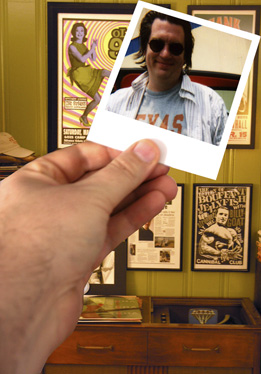
It's funny. Frank O'Hara hasn't been in my consciousness before, say, a few weeks ago when I visited the Beat Generation exhibit at the HRC at UT-Austin. An excellent exhibit, but if you are going to see it, you'd better hurry because it ends this Sunday.
Nonetheless, Frank O'Hara figures prominently in the Season Two premiere of Mad Men on AMC when Don Draper sees a guy at a diner reading the Frank O'Hara book, Meditations in an Emergency. For more about this book, check out Michael Leddy's blog.
At the end of the episode, Don reads aloud the fourth (last) section of "Mayakovsky," the last poem in Meditations:
Now I am quietly waiting for
the catastrophe of my personality
to seem beautiful again,
and interesting, and modern.
The country is grey and
brown and white in trees,
snows and skies of laughter
always diminishing, less funny
not just darker, not just grey.
It may be the coldest day of
the year, what does he think of
that? I mean, what do I? And if I do,
perhaps I am myself again.
For a fictional character, Don sure knows how to move books. When I checked Amazon.com just now, it was the No. 1 selling book of American poetry. Suck it, Robert Frost!
Tuesday, July 29, 2008
Don Draper Knows How To Sell Books

Tom Waits in Atlanta Podcast
Got two and half hours to spare? If you missed Tom Waits on the Glitter and Doom tour, you can catch the rebroadcast of the Atlanta show on NPR. I highly recommend it.
Friday, June 27, 2008
Tom Waits at The Palladium in Dallas
 Photo from Unfocused Mike
A long time ago during my Austin days, my old roommate Russ worked on a movie called The Ballad of the Sad Café being shot on Willie Nelson's ranch out in Dripping Springs. Russ was the stand-in for Keith Carradine, which meant that he literally stood under the hot lights in the hot Texas sun instead of Carradine as they set up camera shots. When everything was ready, Keith would step on to the set and shooting would begin.
Toward the end of shooting, Russ decided he would allow himself to ask Keith one "Hollywood" question. Because Keith Carradine had recently starred in Cold Feet, the question to Russ – and me – was obvious. "What's Tom Waits really like?"
I don't remember much about what Keith told Russ other than something like, "He's a poet, really." I know the answer was much more comprehensive and thoughtful than that, but I was thrilled to talk to someone who talked to someone who talked to Tom Waits. And for years, I was such a big fan of Waits' music that I assumed that any kind of connection to the man would be some sort of transcendent experience.
So when I finally saw Waits in Chicago back in 2006, it was inevitably a bit of a disappointment. It was fantastic, but not transcendent – except for "Falling Down." However, I'm not sure any artist can live up to those weighty expectations.
Nonetheless, my enthusiasm for the music of Tom Waits remains undiminished and I bought tickets to last week's Dallas show the moment they went on sale.
Much has been written already about the lack of A/C and the dearth of bars. And yes, it was freaking hot in there and the line for any beverage -- with or without alcohol -- was unmercifully long. But for the chance to stand within 50 feet of the man for the entire performance, I'm willing to put up with a lot. However,the conditions may have had more to do with Tom Waits than the Palladium management. At the Tom Waits show in Chicago in 2006, the concessions closed 45 minutes before Waits took the stage and I chalked up the lack of air conditioning to the 100-year-old venue. That show was actually much hotter. If Waits wanted to create a revival meeting atmosphere, lots of heat and no booze are the way to do it.
And that's what it was on Monday night -- a tent revival replete with the showmanship, hucksterism and funkiness. And Waits has always been equal parts Howlin Wolf, Kurt Weill and Billy Sunday with a dash of Cookie Monster playing "Greensleeves." And when he played "Such a Scream" and "Eyeball Kid," he even channeled a bit of James Brown.
My biggest complaint was that the mix -- it was muddy and missing all of the high end. But what surprises me is the songs he played that are among my favorites like "Hoist That Rag" weren't my favorite songs of the evening. The songs I liked best were "Lie To Me," "Fannin Street" and "Black Market Baby" -- not songs I listen to all of the time, but he just blows them out live. And all you "Wire" fans have to love hearing "Way Down in the Hole." It's kind of special.
Transcendent? No. But I've moderated my expectations. Exceptional? Absolutely. Waits is a master showman and I can sleep better at night knowing that I've seen one of my musical heroes not once, but twice. If you ever have a chance to see him, you should. You won't be disappointed. I know I wasn't.
Best Books of the Past 25 Years
Entertainment Weekly released its list of 100 Best Reads of the past 25 years and I didn’t fair too well – four out of 100. Here’s the breakdown:
Have Read
7. Maus, Art Spiegelman (1986/1991)
31. The Things They Carried, Tim O'Brien (1990)
57. The Bonfire of the Vanities, Tom Wolfe (1987)
80. Bright Lights, Big City, Jay McInerney (1984)
Have Bought and Not Read
2. Harry Potter and the Goblet of Fire, J.K. Rowling (2000)
9. Cold Mountain, Charles Frazier (1997)
26. Neuromancer, William Gibson (1984)
84. Holes, Louis Sachar (1998)
Will Probably Read Soon
37. Persepolis, Marjane Satrapi (2003)
53. The Amazing Adventures of Kavalier & Clay, Michael Chabon (2000)
64. Underworld, Don DeLillo (1997)
88. High Fidelity, Nick Hornby (1995)
Might Possibly Read Sometime
11. Into Thin Air, Jon Krakauer (1997)
28. Naked, David Sedaris (1997)
50. The Corrections, Jonathan Franzen (2001)
79. The Tipping Point, Malcolm Gladwell (2000)
Would Like To Read But Most Likely Never Will
1. The Road, Cormac McCarthy (2006)
18. Rabbit at Rest, John Updike (1990)
24. Lonesome Dove, Larry McMurtry (1985)
36. Angela's Ashes, Frank McCourt (1996)
42. LaBrava, Elmore Leonard (1983)
47. World's Fair, E.L. Doctorow (1985)
66. A Supposedly Fun Thing I’ll Never Do Again, David Foster Wallace (1997)
74. Friday Night Lights, H.G. Bissinger (1990)
Sunday, June 15, 2008
"A Death in the Family" Revisited
 We are talking now of summer evenings in Knoxville, Tennessee in the time that I lived there so successfully disguised to myself as a child.
So begins one of my favorite book, "A Death in the Family," by James Agee, winner of the Pulitzer Prize for fiction in 1958. Agee was a tortured genius haunted by the death of his father when James was 6, and this novel, published posthumously after his death of a heart attack at age 45 in 1955, is the work of a writer in peak form.
Or so I thought. I read today in The New York Times of a "restoration" of Agee's work to it's original form.
When Agee died, he left a hand scribbled manuscript of a novel that was almost finished. The handwriting was "so crabbed that psychics should have been called in to decode it." David McDowell, Agee’s protégé and literary executor, cobbled together the version of the book that is known and loved today, a lyrical autobiographical account of Agee’s first six and a half years, ending with the death of his beloved father in a car crash.
Scholar Michael A. Lofaro spent years shuffling through the original manuscript to create "A Death in the Family: A Restoration of the Author’s Text," by "tracking down the variants, squinting at Agee’s gnarled handwriting, deciphering illegibilities, comparing drafts, speculating, emendating, annotating — and when it comes to his predecessor McDowell’s version, lacerating."
But was Lofaro able to improve on the original? Will Blythe, writing for The Times says yes:
"At last we have 'A Death in the Family' that appears closer to the author’s original intention. This tidying is good in its own right, but the main reason to celebrate the publication of this version is that it serves as a fresh reminder of the wondrous nature of Agee’s prose — unabashedly poetic, sacramental in its embrace of reality, and rhythmical as rain on a Tennessee tin roof."
I would like to heartily add an "amen" to the previous statement. Even without the novel, Agee would have been remembered for any of his many accomplishments. He was an accomplished poet and a well-regarded journalist who worked for Fortune and time Time in the 1930s. He may be best remembered for his collaboration with the great photographer Walker Evans on their book about the plight of Southern sharecroppers, "Let Us Now Praise Famous Men," but he is also considered the father of American film criticism, which he defined in his book, "Agee on Film." And, if that wasn't enough, he was the credited screenwriter on two classic films, "The African Queen" and "The Night of the Hunter."
I can't wait to read the new version of this old favorite. If you haven't spent time with Agee, seek out his work at the bookstore or library. Or even spend a moment with this overview from The New Yorker. He is an American original worth remembering.
Wednesday, June 11, 2008
7:02 p.m., Wednesday on Magnolia Ave.
I believe in serendipity. Sometimes things just happen that are better than anything you could have ever planned. It's these little surprises that make it worth getting out of bed in the morning.
It was a long day. One of those days where one thing happens and then another and before you know it, it's 7. So I turn off the CPU, grab my bag and begin to head out the door when I see my man, Dan McCarron, Heineken in hand, headed to the fire escape to take seven minutes off of his life. So I grab a cold one and join him.
And in the warm evening sun of a Texas summer, we sit and appreciate the fact that, even though Heineken is kind of a piss beer, sometimes it's just the right thing. It reminds me of drinking beer back in high school, when you were really going uptown if you were drinking Heineken. Of course, that was back in the Eighties when you only had about five beers to choose from.
It's not quite a Proustian memory rush, but drinking a Heineken certainly takes me back about 20 years. And standing in the heat under a wan blue sky in the fading yellows of a disappearing day, telling stories about Coney Island and CBGBs and Joe's Pub and cracking a few jokes with a friend -- I found it an unexpectedly pleasant way to spend a few minutes on a June evening in Fort Worth, Texas.
Yeah, my office is cooler than yours.
Monday, May 05, 2008
Friday, April 25, 2008
Regrettable Moments in Marketing History
My new Starr Tincup work friend David Hisbrook shared this with me, courtesy of American Copy Writer. The moral of the story is this: a ram hitting a guy in the balls is funny. A ram hitting a guy in the balls twice is frickin hilarious.
Wednesday, April 16, 2008
Spring Mix 2008
To all my friends who have asked -- Yes, I've been away. But it's all good. I've got a new job at Starr Tincup down on Magnolia Avenue. It's the greatest place in the world but I am busier than I've ever been, which doesn't leave a lot of time for blogging.
So I am taking the easy way out to get a post up ... I'm leaning on my man the Stash Dauber for inspiration. Here is my Spring Mix for 2008. Check it:
1. PPT > Higher
2. Goodwin > Grace
3. Say Hi > Northwestern Girls
4. British Sea Power > Waving Flags
5. The Raveonettes > You Want the Candy
6. Glen Hansard > Say It To Me Now
7. Band of Horses > The General Specific
8. M83 > Graveyard Girl
9. Nina Simone > Please Don't Let Me Be Misunderstood
10. Joe Strummer > Coma Girl
Sunday, April 06, 2008
R.I.P. Charlton Heston
 Cheston has left the building. Does this mean we can pry the gun from his cold dead fingers now?
I don't know about you, but I like the Omega Man Chuck Heston the best. Kicking it in the velour track suit, chest hair flowing, rocking the sub-machine gun, blasting zombies and playing chess against the bust of Napoleon with a sifter of cognac. That's unfiltered awesome.
Yep, Heston and guns are as inextricably linked as ... uh, Heston and apes. Unfortunately, my most vivid memory of Heston the NRA guy is that whole scene with him at the end of Michael Moore's Bowling for Columbine. I thought Moore made an interesting and compelling argument about the detrimental impact of guns in American society, and then blew it at the end of the movie with his unfair ambush interview of Heston. You may not agree with Heston's views on guns, but the man was obviously not at the top of his game mentally and the "interview" was, I thought, unfair and disrespectful.
Sorry about that Cheston, you deserved better. Still, thanks for defending us from zombies, apes, pharaohs and centurions. I am forever grateful for that. Rest in peace, man.
Thursday, March 20, 2008
Ernie Pyle's Last Byline
 My old friend Mo Stevenson, who I have written about previously, once told me a story about how he came to know Ernest Hemingway back in July 1944. Gen. Raymond O. Barton, commander of the Fourth Infantry Division during the Normandy campaign, called him to his tent one day and asked him if he knew any war correspondents. Stevenson replied, “I know the good ones.” And that’s how Mo ended up riding into Paris with Hemingway a few weeks later.
But the Ernie who was at the top of Mo’s list wasn’t Hemingway. It was Ernie Pyle.
As an old newspaperman and World War II history buff, I have found myself more interested in the past couple of years in going back to the first-hand accounts of the newspapermen (and women) who covered the war.
Some of this fascination came from reading the excellent two-volume set of World War II reportage from Library of America where the reporting of Robert Sherrod, Lee Miller, A.J. Liebling, Mack Morris and Carl Mydans still crackles like rifle fire.
But as great as some of this work is, the work of Ernie Pyle still exists on a different plateau.
Pyle’s ability to tell the stories of ordinary people and capture small moments allowed millions of American readers to understand the war in a different way. The headlines might show readers the movements of armies as giant arrows on a map, but Pyle put you inside the thoughts of the soldier in the foxhole in the rain. The human-scale portraits he painted with his words helped his readers catch a glimpse they could never understand without actually living it.
One example of this is his story of Omaha Beach. If you’ve seen the movie Saving Private Ryan, you know what happened. But although Pyle spent more than his share of time under fire, he wasn’t there on D-Day for that horror. Instead, he wrote a story a few days later about walking down the beach in the midst of the detritus of war. His words bring home the magnitude of the loss in an understated, dignified manner.
It wasn’t the destroyed landing craft or the burned out tanks he wrote about, it was personal affects that washed ashore, “this long thin line of personal anguish” as he called it. It was backpacks, Bibles, shaving kits and snapshots. It was tennis racket. It was a dog looking for its master.
Pyle writes:
“I stepped over the form of one youngster whom I thought dead. But when I looked down I saw he was only sleeping. He was very young and very tired. He lay on one elbow, his hand suspended in the air about six inches from the ground. And in the palm of his hand he held a large, smooth rock.
“I stood and looked at his for long time. He seemed in his sleep to hold that rock lovingly, as though it were his last link with a vanishing world. I have no idea at all why he went to sleep with that rock in his hand, or what kept him from dropping it once he was asleep. It was just one of those things without explanation, that a person remembers for a long time.”
That kind of writing, that kind of empathy earned the appreciation of millions of readers and the affection of the soldier whose stories he told. He shared their dangers and seemed to understand their lives. I understand that sense affinity for the man and his writing because I still feel it today some 60 years later.
That’s why I had mixed feelings about the publication earlier this month of the photograph of the dead Ernie Pyle stretched out on the volcanic rock of a little island off Okinawa where he was killed. Although it was thought that the photo had never been published, it actually had been in 1979. Nonetheless, it was a shocking photo. If you want to see it, go to USAToday
Is this exploitation? Is this sensationalism? Do we really need to see this picture?
I’ve pondered this question for a while. What I have wondered is what this photo tells us about the man. How a person dies doesn’t always tell us anything about the way they lived. But in this case, I believe it does.
Pyle spent the war years reflecting the world he experienced. He wrote often about violent death coming suddenly and unexpectedly to those around him. Pyle knew you couldn’t write about the war and not write about the price that soldiers pay. He probably did that most eloquently in his column “The Death of Captain Waskow.”
In that column, he wrote, “You feel small in the presence of dead men, and ashamed at being alive, and you don't ask silly questions.” I feel a little of that when I look at that photo of Ernie Pyle. For a man who sought to tell the stories of Americans at war, you have to be able to tell The Story of war – people die. Pyle didn’t learn these stories from a distance. He learned them from close up.
One of Pyle’s colleagues – the great combat photographer Robert Capa touched on this in his memoir Slightly Out of Focus. As he was taking a picture of a wounded pilot crawling out of his damaged bomber at an airfield in England, the pilot held the gash in his forehead and cried, “Are these the pictures you were waiting for, photographer?”
Capa was stung by this. “On the train to London, with those successfully exposed rolls in my bag, I hated myself and my profession. This sort of photography was for undertakers, and I didn’t like being one. If I was to share in the funeral, I swore, I would have to share the procession.”
Capa certainly took part in the procession, and so did Pyle. And I think that is part of what this picture of Pyle shows. You do not see a reporter, you see a soldier.
Also, this man is not an anonymous victim of war. When you read this man’s writing today, the words are still living. His thoughts and observations are as real as something that happened this afternoon. And this photograph serves to magnify the tragedy.
Ernie Pyle was very much an everyman – a quiet, unassuming regular guy, a bit of a loner. He hated the war as much as any soldier he wrote about but understood that there was a job to do. When he left Europe at the end of 1944 to go home to Albuquerque, N.M., he could have stayed there. He didn’t have to go back out to the war, but he did. Maybe it was a sense of duty, a longing to escape a less than happy marriage or his innate restlessness. Whatever it was, it led him to that little island off Okinawa where he met his end.
And maybe that is why this photo is necessary to see. We know Ernie Pyle. We can read his thoughts and we still find him to be a hell of a guy. This photo is his last byline and it helps to make the immense scope of tragedy much more real and personal.
To understand a little more about the man Ernie Pyle was, take a few moments to read this excellent look at his life before the war.
Monday, February 11, 2008
The Reivers: I Keep Some Words Here In My Pocket for Such a Rainy Day

For a few moments at The Reivers reunion show at The Parish in Austin last night, it was 1985 again.
The kids who used to smoke cigarettes and drink coffee at Quacks or Les Amis, who used to hunt for records at Sound Exchange on the Drag, who used to queue up outside the Liberty Lunch were there. Most are a little thicker around the middle and maybe showing a little -- or a lot of -- gray. Or a receding hairline. Some of them brought their kids.
But they were there, pulling on a Shiner or a Lone Star, shelving middle age anxieties for a couple of hours to remember what life was like before mortgage payments and Blackberries. One woman -- in true Michael Stipe fashion -- was rocking her FFA jacket. A couple even wore their old-school Reivers' t-shirts.
And it was a good night and a good show.
The Reivers -- John Croslin, Kim Longacre, Cindy Toth and Garrett Williams -- were one of the biggest deals in the Austin scene in the mid-1980s. They never made the splash that Stevie Ray Vaughan did. Hell, they never made the splash Timbuk 3 made. But the two sold out shows over the weekend tell you that even though this band broke up in 1991 without reaching the same heights as other Austin acts, it still has a special place in the hearts of many a current and former Austin resident.
If you are looking for a good overview of who The Reivers were, or maybe you just need a little refresher course, go no further than Michael Corcoran's excellent remembrance on the Austin 360 Web site. He pretty much nailed it, and he was there to know. Below is a video of how they did it back in the day:
Last night, in the second of their two shows, The Reivers sounded like a band that hadn't played together in over 15 years -- not especially tight and they missed a few notes early on. And I'm sad to say that Longacre -- who could make the hair on the back of my neck stand up back in the 80's -- doesn't quite have the pipes she used to.
But these are mere quibbles. The Reivers still rocked and their got better as the night wore on. Longacre jumps around on stage pretty good for a middle-aged mom. Her harmonies with Croslin still evoke the same magic. Toth is still enigmatic. Williams plays the fuck out of his drum kit.
To provide a little more context for those of you in the 817, the Reivers emerged from the Austin scene in mid-1980s as a band called Zeitgeist. You can see them above on MTV's Cutting Edge, circa 1985, along with Daniel Johnston. Cut from the mold of the jangly R.E.M.-influenced bands of the time, they released an excellent album called Translate Slowly, a moody album perfectly calibrated for my brooding teen-age soul. As much as I loved all the songs on that album, what really struck me was two covers: Willie Nelson's "Blue Eyes Crying in the Rain" and "The 4Country Reporter Theme." These guys could rock, but they knew Texas. They were people like me. They loved Willie and Bob Phillips. They even ripped off the Texas Rangers logo of the baseball wearing the cowboy hat for their very own.
I listened to Translate Slowly approximately 150,000 times. I used to look at the back of the album sleeve at the black and white photograph of the band members sitting around a table, playing cards and drinking bottles of Shiner Bock and cans of Bud. I remember thinking, 'Man, Austin's a place I need to get to.'
Back then, that was the music of the future, the siren song of impending adulthood. And Austin called out as a good place get life started.
And I got to Austin. By the time I arrived, a lawsuit from another band with the same name prompted a name change to The Reivers, but I saw them and Joe Ely and the True Believers and a bunch of other great bands play during my time there. And I smoked cigarettes and drank Shiner, played spades and hung out with my friends just like those kids on the album sleeve. I even met my first Austin girlfriend at a Reivers' album release party on a cold, blustry winter day in the parking lot of the old Waterloo Records location.
And though the girlfriend wasn't around much longer than an album side, one cut off of that record, The End of the Day, I still carry around with me to this day. It was the next-to-last song they played last night, "Star-Telegram." It's still my favorite song ever about Fort Worth -- a beautiful piece of 1980s nostalgia for growing up in the early 1970s.
And that's where everything turns around. As I listened to that song last night, I was very aware that it was not a part of the soundtrack of my future, but rather my past. Now, when I put those old albums on and thoughts of Austin spin above my record player, I'm in Fort Worth. I've got a kid of my own who wears t-shirts and listens to rock music. Funny how that happened so quickly.
But, I'm lucky. Sure, time goes by all too fast, and many of the kids I enjoyed those Austin days with are now scattered all over the globe -- from Brazil to Ireland to Australia. But I still have some good old friends around who remember those days. And from time to time, just like yesterday afternoon, we can sit under a towering oak tree on South Congress in the long shadows of afternoon and share a drink and a laugh and listen to a little music.
That's really what I took away from last night at The Parish. -- for me, Austin is like Hemingway's Paris -- it's really a moveable feast. There's never any end to it. No matter how much you change or it changes, you can still return to it. And it's always worth it.
To Kim, John, Cindy and Garrett, thanks for the reminder. Thanks to Russ and Shannon for a good trip.
Thanks to jbeckham for the photo.
UPDATE: Read the Austin 360 review here.
Friday, February 08, 2008
Bemstar Wants a Hug

I love Godzilla kitsch. So does this guy. Check out his Totally Awesome Flickr Set of Japanese monster toys. Thanks, Boing-Boing!
Monday, February 04, 2008
What's The Best Kind of Bear?
 Dwight Schrute once asked one of the fundamental questions of our time. OK, actually it was Jim Halpert pretending to be Dwight Schrute, but an important question it is -- what is the best kind of bear?
Jim said black bear. I wish to offer an alternative.
What's the best kind of bear? I say a beer-drinking, cigarette-smoking, mortar-shell carrying bear who fights Nazis. That kind of bear is Voytek the Soldier Bear. And Voytek kicks ass.
This story has been a topic of discussion in my house for several days. According to the BBC, who presumably thoroughly fact-check this kind of thing, Voytek was a bear that Polish soldiers found wandering in the hills of Iran in 1943. Apparently a docile creature, the bear became the unit's mascot and was trained to carry heavy mortar rounds. Which he did during the Battle of Monte Cassino.
"He was just like a dog - nobody was scared of him," said Polish veteran Augustyn Karolewski. "He liked a cigarette, he liked a bottle of beer - he drank a bottle of beer like any man."
When the troops were demobilised, Voytek spent his last days at Edinburgh Zoo where he died in 1963, presumably of lung cancer. Now, the good people of Edinburgh and Polish veterans are trying to get a memorial built for Voytek. Here's hoping they do it. You can send a letter of support to the The Scotsman in Edinburgh.
Exhibit B: If you need more evidence that bears kick ass, allow me to point you to The Bible, by way of Cracked magazine. Yes, we are sinking that low. The topic is 9 Most Badass Bible Verses. The subject is Number 8: II Kings 2: 23-24. "From there Elisha went up to Bethel. As he was walking along the road, some youths came out of the town and jeered at him. "Go on up, you baldhead!" they said. "Go on up, you baldhead!" 24 He turned around, looked at them and called down a curse on them in the name of the LORD. Then two bears came out of the woods and mauled forty-two of the youths." See -- even God knows that bears are awesome. And who hasn't wished they could summon up some bears to deal with wisecracking juvenile delinquents? Think about that the next time you're at Hulen Mall.
A Word About My Man PeteG

My good friend and West and Clear blogging colleague PeteG really gobsmacks me with his talent. Case in point -- the image above. I love the composition, but what really get me is the quality of the color -- the sky, the wall, the sand. The color is exquisite. And that's when Pete would say, "It's the light, man. It's all about the light."
In a word, awesomez.
Tuesday, January 22, 2008
Once
The Oscar nominations are out this morning and even though I don't get out to the movies quite like I used to, my first thought was ... wow, what an odd, highbrow year. Just when you think that American civilization has completely bottomed out, Cormac McCarthy and Upton Sinclair are in the running for Best Picture.
But the biggest, most pleasant surprise of the morning was from the most unexpected, moving film I have seen in quite some time. Among the nominations for Best Original Song -- "Falling Slowly" from the film "Once," by Glen Hansard and Marketa Irglova. You can see the video above.
It's a beautiful song and beautiful film. I can't say enough about it. In a film landscape when everything seems to be an onslaught of robotic violence, serial killers and trite fantasies for the Bratz generation, along comes this quiet little realistic Irish film that is sweet and touching. It's just a simple story of two people sort of falling for each other and making music. And we find -- not surprisingly -- that people's lives are complicated things.
But unlike many music films, the story doesn't take a backseat to the music or vice versa. Hansard and Irglova are two very capable musicians who can also act. The music doesn't feel like a departure from the narrative thread -- it moves it forward.
Do yourself a favor and see this movie. And tell a friend. You'll be glad you did.
UPDATE: The Onion AV Club interview with Glen Hansard.
Tuesday, January 15, 2008
What's the Deal with Steve?

I feel normal. Why do you ask?
Actually, that's my cat, Bucky. I need something to get the .38 Special thing lower on the page. And, I kind of like that picture.
But I have been getting that question a lot lately. For those of you who may not know it, I've been spending a lot more time at my other blog, West and Clear. I've actually been quite busy. Drop by and check it out.
But that leads in to my thoughts for today. Over the past several months since the beginning of West and Clear, my blogging has been a little schizophrenic. Do I post something on the Caravan? On West and Clear? On both? And that doesn't get into my other other blog.
In short, I have three blogs, and given the demands of my life, it seems that any one of them can be good at any one moment. I'm trying to change that, but you can only spend so many hours a day behind a keyboard.
And to call West and Clear "my" blog is not the whole truth. I am a proud papa, but West and Clear has four other fathers. Bernie, Kevin, PeteG and PeteW joined our mighty blogging powers because we wished to be the kings of all media in Fort Worth and crush all those who sought steal that mantle from us.
Actually, I kid.
We came together as a bunch of blogging SuperFriends because we love Fort Worth and want to tell its stories. So far, it's working. Together, I believe we are better bloggers collectively than we are individually. We feed off off the group energy. We like each other. We enjoy our work.
And the readers of Fort Worth have responded. Many of you are already West and Clear readers and some of you even take the time to leave your comments. Thank you. We've met you out in the community and you've encouraged us to keep writing. One frequent comment we hear goes like this: "I finally feel like I know what's going on in Fort Worth."
Again, thank you. I'm flattered, but I haven't drank that much of the KoolAid yet. However, I do believe that West and Clear fills a need.
So, you may be wondering, what does that have to do with The Caravan of Dreams?
A lot.
I'm tired of double-posting or trying to figure out what goes where. And, I believe some of my readers are confused, too. So I am adopting a new policy.
Effective immediately, those of you who are looking for my musings on urban gas drilling, local politics, local media, local music, local arts coverage or any other Fort Worth topic, head over to West and Clear. It's all there. However, those of you who are looking for the occasional musings on God, Godzilla, books and any other cosmic questions that are rattling around in my attic, you'll find that nonsense right here.
I know most of my readers are interested in the Fort Worth topics, and I enjoy writing about them. But The Caravan of Dreams is still pretty special to me and I hope y'all will continue reading here, too. I started blogging a few years ago as a way to make sense of my life after my father died. I don't know what I was expecting to find, if I was trying to write my way to some sort of answer of what life is about. If that was what I was looking for, I didn't find it. I'm just as clueless as before.
But I did find that writing stories helps. It's therapeutic. I grew up avidly listening to stories and I always hoped that I would be able to one day tell stories of my own. Honestly, I don't think I'm very good at it, but I enjoy the hell out of it. I enjoy the hell out of my life and living in Fort Worth. And, above all, I am not short of observations. So this blog will continue to be the old shoebox filled with the trading cards, paperclips, wheat pennies and bottlecaps of imagination.
So, read me at West and Clear, but read me here, too. I promise interesting reading at both sites. And two out of three ain't bad.
Wednesday, January 09, 2008
Panther City Bikes on YouTube
Bernie over at Panther City Bikes just posted this little promo video on the PCB blog. In his post about the video he writes: "Behold the raw power of what Jason likes to call my ".38 Special" 'stache!"
Is this indeed a .38 Special mustache? Watch the video and then judge.
As for me, I'm already convinced. Jason, you nailed it. I offer you Exhibit A, the guy on the left:
BTW, you can actually vote on whether on not Bernie should grow his stash back. Visit the PCB blog to cast your vote. But hurry up, because only two days remain.
Los Noviembres at Embargo Tonight

Looking for something to do on a Wednesday night? Head over to Embargo and check out Los Noviembres, the electrojazzblues cocktail mixed by Paul Boll and Angie Cassada. Think bossa novas and jazz standards. Astrud Gilberto. That kind of cool. Show starts at 10.
Goodbye, Wendy. Hello, Joel.
Wendy Davis said goodbye to the City Council last night. Joel Burns took his seat as the new District 9 representative. Was there drama?
Oh, you bet. This is District 9 after all. Read the whole story at West and Clear.