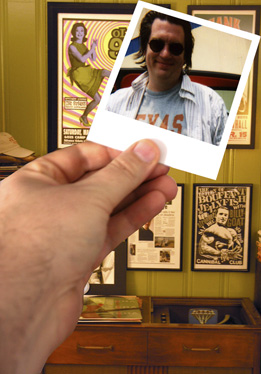
I wanted to give you an update on the Breakfast with Lon Burnham event from Saturday, and I'll need to start off with an apology. I don't have my notes with me so I'll have to do this off the top of my head.
I joked with my wife before I left that I was going to have breakfast with the three other liberals in Fort Worth, but actually, the turnout was about fifty people -- many of the them the usual suspects (Democratic Party faithful, activists, labor organizers). When I met Lon on the way in, I thanked him for his efforts to prevent further infrigements on civil liberties in the state. I also thanked him for his work in a hostile environment. "It wasn't hard at all," he said. "In fact, it's a lot of fun."
He then went on to answer my burning question coming in to the breakfast was this: how can you hope to get anything done for your district when you probably the least favorite House member of the autocratic Speaker, Tom Craddick?
Lon has long since accepted life in the wilderness. If Tom Craddick could "disappear" one person in the House, it would probably be Lon. So Lon has gotten used to life wearing a bull's eye. His bills will rarely -- if ever -- get out of committee. His life is one of not so much trying to get bills passed to help his constituents as it is trying to stop legislation that would hurt those in his district. And there is plenty of bad legislation to deflect. He used a point of order to derail a bill allowing the state broad use of wiretapping. He also help defeat the Voter ID law -- a 21st Century version of the poll tax -- that would have successfully disenfranchised many poor and minority (read Democratic) voters.
But his work wasn't all defensive. He managed to get the state to divest from companies doing business in Sudan and pass a law approving a sales tax holiday on environmentally friendly household items like longer-life light bulbs and insulation.
But he was most upbeat about the possibilities of having a new speaker in the House. Craddick's act has worn thin with Republicans. Lon hinted that the Craddick D's -- the House Democrats that have sold out to Craddick -- will all face tough primary fights in the next election. The foundations that Craddick has built his leadership on are looking a little thin.
And there was even strong evidence of bi-partisanship with Lon having more than a few positive comments about a couple of House Republicans from Fort Worth -- Todd Smith and Charlie Geren.
I really left with a sense that there is some sunshine in Texas for those of us on the left side of the political spectrum. Sure, this is still the reddest of the red states. But if we engage and get involved in this next election cycle, maybe we can begin to turn some things around here in the Lone Star State.
Monday, June 04, 2007
Breakfast with Burnham Update

Sunday Leftovers
I didn't spend much time with the Sunday paper, but this did jump out at me: J.R. Labbe, one of the more consistent conservative voices on the Startlegram's op-ed pages, announced that she believes Iraq is a sideshow from the War on Terror. Wow, the tide is really turning against this war.
Friday, June 01, 2007
I'm Buying a Lotto Ticket NOW
 Because I know what I will spend it on -- this coolio pad in downtown Austin.
Alejandro Escovedo with Roky Erickson
The two Austin legends play tomorrow at Battery Park in NYC. Wow. That should be a great show.
Charles Nelson Reilly -- NOOOO!!!
 I don't know about you, but I spent a lot of time back in the go-go 70s watching Match Game. So I was sad to learn that Charles Nelson Reilly, the Tony Award winner and professional gadabout, has left the building. He was 76. Sez the San Jose Mercury-News, "Reilly's openly gay television persona was ahead of its time, and sometimes stood in his way. He recalled a network executive telling him 'they don't let queers on television.'" Wow. What I didn't know was that there is CNR documentary. Fabulous! I can't wait to see it. And no, Paul, I'm not telling my Paul Lynde story.
A History of Guns: Part Three
 This is the third in a personal history of guns in my life. Previous entries: Part One, Part Two
The Junior High Years
By the time I got into junior high, real, live guns became a part of my life. Looking back, I never worried about some kid bringing a gun to school and pulling a Columbine, but I became aware that guns weren't just in the guestroom closet. They were around and they could be lethal.
When I was in eighth grade, a seventh-grader killed himself because he was upset about breaking up with his girlfriend. I don’t even remember that kid’s name now but it had a deep impact on my middle-school psyche. Then there was the Mexican kid in gym class named BB who was older because he was held back a few times. He fucking tormented us, any we hated him in return. But that’s just junior high, right? A couple of years later, he killed himself and it turned out he was dealing with some pretty horrible home issues -- abuse, that kind of thing.
Then there was Freddie.
I always liked Freddie. He moved into the neighborhood in eighth grade. He talked a lot and was funny and a bit crazy, but I liked being around him. We’d play football with the other guys after school.
Freddie was the kind of kid you would hate as a parent: he was obnoxious and he made your kid more obnoxious and it was easy to tell Freddie wasn’t headed for anything good. Well, one day we went into Freddie’s house to get a Coke after playing football in the street (we were bright kids), and there is a 9mm automatic pistol just sitting on the kitchen countertop.
No one touched the pistol, but we were all transfixed by it. Even my 14-year-old mind knew that this was not responsible gun ownership. Anyway, Freddie told us he wanted to show us his gun. Yeah, you can probably see where this is going. Before you could say “Smith and Wesson”, he’s dancing around his bedroom like a freaking idiot with a single-shot .410. My friends and I got out of there quick. Even we knew that was how kids get killed. Yeah, Freddie was bad news, but he eventually drifted off into his own little world with the other pot-smoking freaks in Iron Maiden t-shirts who sat at the back of the school bus.
Meeting Resistance
 I found out about this documentary on XM's Bob Edwards Show this morning: Meeting Resistance, a behind the scenes look at the Iraqi insurgency. It answers the question: who are these guys? The answer is not criminals, al-Qaida, Baathist or dead-enders. For the most part, these are regular Iraqis and many of them didn't begin as radical Muslims, but many seemed to be heading in that direction by the end of the film. If you don't have XM, you can read an interview with the filmmakers here.
When I first heard about it, I have to say I felt uneasy about it. Regardless of how you feel about the war, watching insurgents assemble an IED to blow up Americans doesn't sit well with me. I know people who have been to Iraq and I I know people who will probably go back. I know there are people who will seize on this as a Hanoi Jane moment.
But a curious thing is most of the early screening of this film have been at such liberal bastions as the Marine Corps base at Quantico, West Point and England's Royal College for Defense Studies. It seems the military finds some value in pulling back the curtain on the insurgency.
What have the military learned from the film? "We came to know who funds them [broadly speaking] and where they get their weapons, who and how they recruit and what effects US counter-insurgency operations have on their will and effectiveness to fight," said the filmmakers in their directors' statement. Another lesson comes from an article in Government Executive (and that entire article is quite an eye-opener for anyone interested in counter-insurgency lessons learned.):
A particularly illuminating 2006 documentary film, Meeting Resistance, by journalists Molly Bingham and Steve Connors, who spent 10 months interviewing insurgents in Iraq, revealed that the weapon the insurgents hated and feared most was the American dollar. Dollars could buy people, Iraqi informants, who could identify the insurgents who otherwise blend into the population.
So what's the takeaway? Do the filmmakers have an agenda? Yes. Do I agree with everything they say? No. Has this changed how I look at Iraq? Maybe a little. I have actually favored staying in Iraq because I fear that pulling up stakes and leaving would actually make a bad situation worse. After listening to this interview, I'm not so sure.
Thursday, May 31, 2007
Horse Slaughter Update
I don’t know how I missed this, but evidently horse slaughter plants in Fort Worth and Kaufman will stay closed. Now that Illinois has outlawed its horse slaughter plant, it appears that this is the end of slaughtering horses in the United States for human consumption abroad.
A History of Guns: Part Two
 This is the second in a personal history of guns in my life. Click here for Part One. Click here for Part Three.
The 1970s
I was born into a God-lovin’, gun totin’, Republican votin’ nuclear family (As my friend Kerry once said, "How the hell did you end up the way you are?" It's a long story.) But I guess it shouldn't surprise that I was fascinated with guns. But while guns were in my house, they weren’t visible. Dad kept his guns locked up and the only time I saw them was when he carried them from the guestroom closet where he kept them to the trunk of his car for a hunting trip. His message was always clear: guns and kids are a bad mix, so leave guns alone boy.
Looking back, I guess it seems odd (to me) that I didn’t grow up with guns. When Dad went hunting, he went with his friends or just by himself. I remember one day him tromping off in the snow into the woods behind our house to hunt quail. I sometimes wondered why I never went hunting with Dad. I used to think it was because I wasn’t old enough. Now I know he just wanted to get away from a couple of kids and a pain-in-the-ass wife. I never really thought anything about it until many years later when I watched my neighbor, a big-time bird-hunter, take his six-year-old son dove hunting with him. I was a little surprised, but that's part of the indoctrination into the gun culture that I obviously missed and maybe explains why I am the way I am. In 15 years, that kid will be one of those guys who drives around in a Tahoe with a Ducks Unlimited sticker and baseball cap. Except maybe not that kid. My wife and I thought the kid would probably grow up to be gay and the parents were just over-compensating. So maybe it's a Subaru Outback and a rainbow sticker. But that's beside the point. It kind of makes me sad looking back. I could care less about the guns and the hunting. But I miss not getting to spend time with my Dad.
Most pro-gun people are quick to bring up the personal defense angle in their defense of firearms. But using a gun to protect house and family from crime wasn’t in my Dad’s experience either. I remember one night when we were worried about a prowler around the house, I asked Dad if he need to get his gun. He looked at me as if I had asked him if he needed a hot-air balloon. He didn't need no damn gun.
Anyway, for me, guns weren’t any more real than the plastic Thompson gun I used to carry playing war games or the westerns and war movies that were the staple of my television viewing. Things didn't stay that way.
Late Night Biking
Drop by Tammy Gomez's blog for her post on last night's screening of the B.I.K.E. documentary. I wish I could have been there, but I can't be everywhere. Maybe next time?!
So I Met The Stash Dauber
As my man The Stash Dauber has already chronicled (BTW, don't you EVER sleep man!) I had the honor and good fortune to tip a few with the man live and in person at the Wreck last night. We had quite a bit to talk about, but most of it revolved around the topic: what is the nature of "a scene."
I really kind of hate the word "scene" anyway because it sounds kind of pretentious. And I guess in a way it is supposed to be pretentious and exclusionary. But the word I like better is Stash's word: community. And when you talk about community, it becomes easier to talk not just about the people -- the scenesters if you will -- you can talk about the place and the places. And that's my favorite topic -- what gives Fort Worth its sense of place.
When all of the Apple Stores and all the high-end condos are finished, will Fort Worth lose something? As Stash pointed out last night, the artistic, creative types are harder to stamp out than cockroaches. They find a way to survive. And in Fort Worth, unlike Deep Ellum, the "scene" isn't ghettoized. It's all over town.
But I think it is still a question worth asking. As we build all these new buildings and swim in sea of money from the Barnett Shale, are we losing some of that old Cowtown character?
Also, Stash and I talked about my new pet project: a zine mining all of the old 80s punk rock tales from the D and the FW -- the Axis, the Hop, the Twilite Room. I've already told Stash that he's drafted. Mike, Russ, Sean and Joel -- you guys are next. And anyone else who wants to hop on board -- drop me a line on the gmail at the (dot) caravan[dot] of [dot) dreams.
By the way, Stash, thanks for the books!
Tuesday, May 29, 2007
A History of Guns: Part One
 Lately, I’ve been thinking about guns. Americans love to fight about guns. The stereotype is conservatives love ‘em and liberals hate ‘em. Guns are right there with abortion and gay marriage and Iraq when you talk about hot button issues (check out these comments at Grits for Breakfast if you've forgotten how geeked up people can get on this subject.)
My own feelings about guns have been quite complicated. I've been a gun owner and very pro-gun. I've swung to the other side and been very pro-gun control. Now, I'd say I'm somewhere in the middle. Above all, I'm a civil libertarian, and, as my good friend Mike and that big, fat lawyer brain of his likes to point out, you can't pretend the Second Amendment isn't in the Constitution. Fair enough. So I wanted to track how I got here by doing a personal history of guns in my life. This started out as one post but it got longer. And longer. And longer. So I broke it up into parts that will gun on consecutive days until I'm done (which as of right now, I'm not.) So let's get started.
Before the Beginning
My own relationship with guns actually goes back to before I was born. I had a great-grandfather Hughs who was kind of a bad dude who gunned down several men. He killed three men who tried to rob a barn dance where he was playing fiddle. He later gunned down a U.S. marshal in what may or may not have been self-defense. The government’s side was Hughs was running a still on his property (which he was), and the marshal was murdered when he tried to arrest Hughs. Hughs' side of things was the marshal started firing into the house while his two baby girls (my grandmother and great aunt) played on the floor. We’ll never know the answer because Hughs was gunned down in a robbery attempt before the case could go to trial.
I know. Kind of a bloodbath. Such was life in turn-of-the-century Oklahoma. The culprit in Hughs' murder later killed himself in jail, haunted by the ghost of my mean sumbitch of a grandpa. More family lore: Many years later, there was a drunken murder involving some cousins -- I never got the full story on that one. But that’s my pedigree. A bunch of drunk-ass, mean-ass, murderous Scotch-Irish bastards. That's my mother's side.
Not all of the stories were that sorid. My father was an outdoorsman and grew up poor in the country, so hunting wasn’t just something to do, it was a way to put food on the table. Later, Dad was in the Army, and then made a little money so hunting became a social activity and not about sustenance. But, the fact is he was comfortable with guns. He wasn't one of these you-can-have-my-guns-when you-pry-them-from-my-cold-dead-fingers types, but he was an NRA member.
So that gets us from the dawn of time until the late 1960s. Tomorrow, we talk about my formative years.
Click here for Part Two.
Interview with Kenney Mencher
 I’ve been a fan of Kenney Mencher since I first saw his work on the Hang Art Gallery Web site. While some of the work at Hang is the type you would expect to see at a gallery catering to the San Francisco loft-dweller demographic – placid landscapes and color fields – Kenney’s work was different. A sexy-looking gal cavorting in the bedroom with Scooby Doo, scenes from hard-boiled detective stories and lots of small moments and stolen glances. He’s a storyteller with a strain of darkness and a wicked sense of humor. What’s not to love?
If you drop in at his Web site every few weeks as I have over the past few years, you'll see the work of an artist who is contemporary and classical at the same time. His work is very much of the 21st Century but his themes and technique are timeless.
If you live in the Dallas / Fort Worth area or can get here between June 7 and July 1, Kenney’s work will be showing at the Dahlia Woods Fine Arts at 600 Cantegral Street in Dallas. He also has a solo show scheduled at the gallery for September. Kenney was kind enough to swap e-mails with me ahead of his Dallas shows. Please take a few minutes to learn more about him. I think you’ll be glad you did. The Caravan of Dreams: Some your work involves nudity and sexual themes such as voyeurism and power. I suppose it shouldn't surprise that your work has been controversial. However, I live in Texas so I sort of expect that thing. How does your work get called too "wry and perverted" in San Francisco?
Kenney Mencher: One reason might be political. Some other artists who started showing at Hang showed some work that was similar to mine. These artists dealt with difficult themes, especially dealing with female and male sexual dynamics, however, since these artists were female painters I think the staff at Hang felt that these female’s artists’ work were feminist statements. I’m a man so I think that there was the perception that my work, even though it called attention to negative stereotypes, still was not really “feminist” in content. (Ed note: Click to see a larger version of "Apocrypha" from above. For other Not Safe For Work Images, click here, here and here.
Other reasons may be that I pushed the themes a bit too far and was too edgy for Hang as a venue. Hang was interested in representing emerging artists they were not a “cutting edge” gallery. Hang was not really interested in cultivating the counter culture or avante garde art scene or its collectors. Hang’s business model was to cater to educated upscale thirty something professionals who were interested in decorating an apartment. Decorative artwork sells much better than artwork that is designed to provoke thought or challenge the viewer. You would be amazed at how conservative this segment of the population in California and San Francisco is in general.
At the other end of the raunchy spectrum, there are some edgier galleries [ed warning: the links are NSFW] (The Shooting Gallery, Varnish, and 111 Minna to mention a few) who do show edgy provocative “outsider” and “visionary” work that is purposefully meant to provoke and titillate. My work is not considered edgy, cool, or really dirty enough in content to get me into one of those galleries. I also think that my style of rendering is too conservative for these venues. I’m a little stuck between two worlds.
TCoD: Do you intend your work to be provocative?
KM: Yes. I want it to be thought provoking but not necessarily titillating in an overtly erotic way. TCoD: Do you ever get tired of answering questions about the Scooby Doo painting?
KM: I never actually answer those questions directly. I’m more interested in finding out what people think is going on in that painting. What do you think is going on in that painting?
TCoD: Another word I see in a lot of your reviews is ambiguous? Do you intend your themes to be ambiguous? Or do you have a theme or message you want to convey?
KM: The only thing I’m clearly trying to get my audience to do is laugh or be amused. Second on my agenda is to be deliberately ambiguous in that I don’t have a definite or clear story as to who the characters are or what they are doing in the painting.
TCoD: What are the themes that interest you as an artist?
KM: If I was to give myself a shopping list of themes or motifs each painting should address they are: interpersonal communication, sexual dynamics and roles, and story telling.
TCoD: Does your work get compared to John Currin?
KM: My friends do but the people who have reviewed my work in the newspapers don’t even seem to know who he is. I think he’s good but very different from me. He doesn’t seem to tell as much of a story as I do. He is doing some similar things in terms of the themes and motifs that I discussed before but he also varies a lot more in terms of formal things in his paintings. He purposefully awkwardly drafts the human figure. He also changes the way he applies paint from show to show. I actually think I have more in common with Eric Fischl.
TCoD: In your earlier work, your brushwork was much more impressionistic, but now it is much cleaner, smoother and more refined? Was this just part of your evolution as a painter? Or was this more of a deliberate shift on your part?
KM: I’ve actually refined my style quite a lot especially in the larger more ambitious paintings in which the narrative is more specific. I still do some smaller paintings in that quick oil sketch or 1940’s pulp illustration style. TCoD: Much of your earlier work drew heavily on film noir themes for characters and composition. Your current series of Sequential Narratives (such as "Little Did He Know" at the right) seems to draw on more contemporary film and TV shows. How do you believe film and TV has influenced you as a painter? Does David Lynch fit in there anywhere? Is your film noir period over?
KM: I think that film and TV are my primary influences. Even more than traditional art historical sources. The way television and film tell the story, how they frame the images and compositions, and even the lighting are really important to me and I think about them all the time.
David Lynch. Hmmm. . . I’ve seen all of Lynch’s films and I like David Lynch in theory, but, he tries way too hard to be weird. I think he tries to shock whereas I actually like to be more predictable in my scenarios. I think I would still be making the paintings I do even had I not ever seen one of Lynch’s films. TCoD: What's with the waterglass paintings? (See "Pollyana" at left)
KM: There’s a feature about that particular series in “The Artist” magazine this month. You can tell a lot about a person just by asking them, “Is the glass is half empty or is it half full?” I like painting portraits and still life and this was a perfect excuse do just that but with a thesis or theme in which to explore. I guess they are the visual equivalent to a haiku. They are limited in form but within the formula, a half glass of water and a character, you can say and explore a lot of ideas.
TCoD: To me, one of your most interesting paintings is Los Angeles. It reminds me very much of the painting "Second Story Sunlight" by Edward Hopper. But the figures also have this Thomas Hart Benton feel to them. Is this a meditation on aging and fleeting youth? Is this a metaphor about Los Angeles? Is there a homoerotic subtext? What's going on here?
KM: Yes, you are completely correct! (That’s what I say to anyone who interprets one of my paintings.) TCoD: Your more recent paintings seem to involve quality of light more and more. Your earlier work seemed to deal more with cinematic lighting, but now you seem to be dealing more with natural light (such as "In Martini Veritas" at right). Am I just making this up or is there something to it?
KM: Yes, it has to do more with my abilities as a photographer and a painter. I’m getting better reference material. I’ve also learned a lot more about observing and painting light and color in the last year.
TCoD: Your wife, friends and students dress up and play characters in your paintings. Do people volunteer for this or do you choose your subjects?
KM: It’s a combination or a negotiation. I do keep a sketchbook of written out scenarios. I go to thrift stores and get the clothing I need and then I throw a party or visit a party at a sympathetic friend's house. It helps if everyone is drunk. I also ask my students to pose sometimes. You would be surprised how many people are hams.
TCoD: How long does a typical painting take? How much revision is involved and is that a process you enjoy?
KM: Size counts but let’s say one of the glass of water paintings as a midsize one 36”x48” would take about 40 to 60 actual hours to make. This is spread out over several weeks and I usually have two to three paintings going on at the same time.
It starts with writing out the scenario. The photo shoot is usually around two hours (setting up props lights and actually shooting.)
Next is three to five hours of Photoshop on the computer composing, moving things, analyzing light and color and modifying different versions of the batch of reference photos.
Laying out the drawing takes around two to three hours.
The acrylic underpainting takes about eight hours. Often I redraw and reblock in areas of the painting while in this phase. My wife actually tells me when things are off or look bad.
The last layer of oil paint usually takes two to three eight-hour days. This phase runs about twenty-four hours. During this phase I go back the next day and fix the problems that I had not noticed the day before.
TCoD: You explain on your Web site how you use photography to assist you with your composition. Because you make such extensive use of photography, is it a challenge to keep your work painterly and not photorealistic?
KM: It’s not a challenge at all for me. I paint as if I was painting from life and the forms are not abstract for me. When I paint a hand I think of the muscles and skeleton under it so I still lay the forms down by blocking them in a wet into wet 19th century style. I actually think I have more in common with Sargent, N.C. Wyeth and pulp illustrators than I do with photorealists like Bechtle or Estes. TCoD: Now that you mention it, I can definitely see the influences of Sargent, N.C. Wyeth and pulp illustrators. But I also can see classical influences (see "The Calling of Marc" at right) in some of your work that I just can't place. Can you help a brother out here?
KM: Oh yeah. . . Don’t get me started. I think that one of the greatest painters that ever lived was Velasquez and tracing back from there Caravaggio. I sometimes flatter myself into thinking that I’m a modern caravaggisti (Italian for follower of Caravaggio). I love both those artists for their use of everyday items and things and for their very theatrical shifts of light and shadow. I’m an art historian so I look at old masters’ works all the time. I’m constantly stealing from art historical sources such as Artemisia Gentileschi, Michael Sweerts, Vermeer, and Rembrandt.
Still, in the words of Chauncey Gardner, “I like to watch.” Even more to the point I love to look at all art. One of my all time favorite artists is David Tomb. Recently artists like Lucien Freud (NSFW), Bo Bartlett, and Odd Nerdrum are some of my favorite views but I also love graphic novelists and artists like Frank Miller and Alex Ross. I also really dig some vernacular photo web sites such as http://www.bighappyfunhouse.com.
TCoD: I saw you used to teach at Texas A&M in Laredo? That seems like, um, an odd fit. How did that go?
KM: Not so well. They liked me because I was a far out import. The political, economic, and moral climate of Laredo seemed toxic. I found the town and the people of Laredo to be very much in line with the film “A Touch of Evil.” I actually took a $10,000 pay cut to move back to the San Francisco area. I would have stayed if my job were in any other Texas city. I really like Dallas, Austin, and San Antonio. My wife and I would flee Laredo once or twice a month and spend weekends and holidays in these cities.
TCoD: I see your going to be showing in Dallas again at the Dahlia Woods Gallery. You've shown in the past at Craighead Green. How did it go the first time and why are you coming back?
KM: Ineffable stuff happens sometimes and you just lose a gallery for random reasons. Craighead Green broke up with me I think because they just stopped selling my work. I’m not sure how or why I had a great run of sales with them initially but then they stopped being able to sell the work after the first two years. Dahlia actually bought some of my work while on a trip to San Francisco. A year or so after Craighead Green stopped returning my calls Dahlia opened a gallery. I contacted her and now we are working together. It’s funny, she and I went to the High School of Art and Design in New York although at different times. At least she likes my work enough to literally put her money where her mouth is. Go figure! TCoD: I love your Web site, and one of the most interesting things about it is the blog where you show step-by-step the process of creating a painting. I know that lots of bands and musicians are using the Web and blogs to break down the walls between them and their audiences, but I haven't seen as much of that between an artist and his audience. Does your Web presence help you communicate with your audience/customers or is it something more for the benefit of your students or is it a little of both? I'm wondering why I don't see more artists doing this kind of thing. Is it I just don't get out much?
KM: My Web site is one of the best outreach tools I have. I love to correspond with people about art and yes, the website does tend to break down barriers and add to communication.
I primarily began it as a tool for my students to use and have access to all of the lessons and images that I use in both my art history and studio courses. It has developed organically as a public relations tool, mainly because I wanted to share what I know about painting.
I’m also interested in what my audience has to say about the work. The blog takes an enormous amount of work and I am actually backlogged on it right now. I have a ton of digital images that I haven’t edited or posted yet as step by step examples of how I work.
TCoD: Thanks, Kenney! Drop us a line when you're in town.
Thoughts on "Decline of News"
There’s a thought-provoking column by Neil Henry in the San Francisco Chronicle called “The decline of news” that calls out Google and Yahoo for generating handsome profits at the expense of the newspaper business:
It is no longer acceptable for Google corporate executives to say that they don't practice journalism, they only work to provide links to "content providers." Journalism is not just a matter of jobs, and dollars and cents lost. It is a public trust vital to a free society. It stands to reason that Google and corporations like it, who indirectly benefit so enormously from the expensive labor of journalists, should begin to take on greater civic responsibility for journalism's plight. Is it possible for Google to somehow engage and support the traditional news industry and important local newspapers more fully, for example, to become a vital part of possible solutions to this crisis instead of a part of the problem?
While I agree with the assertion that the news business is suffering right now and a healthy media is a key ingredient in a healthy democracy, Henry is glossing over a few key points:
I’m very sorry these people are losing their jobs. Some of them are my friends. But if you want to get mad at someone, get mad at the suits running your newspapers into the ground – yeah, I’m talking to you Tony Ridder. It’s their lack of vision that got you into this mess.
BTW, thanks to Romenesko for the tip!
UPDATE: More on this topic in Romenesko''s letters.
Three Old Favorites, Continued
As I mentioned previously, The Stash Dauber has weighed in with his Three Old Favorites. Now Stash’s Philly friend Andrew from Headlock Harmony answers the bell with his list.
Breakfast with Burnham
I got an e-mail from my new e-friend, Lon Burnham -- or at least the person who answers Lon’s e-mails. Mark your calendars now for Breakfast with Burnham – at 8:30 a.m. this coming Saturday, June 2, at Tunero Mexican Restaurant, 1549 N. Main Street, in the 76106. If you have questions, call 817.924.1887. The discussion will be on the highlights (or lowlights) of the 80th Legislative Session. Lon is one of the consistent liberal voices in Austin who still believes in accountable government and civil liberties matter. I’m looking forward to thanking him in person for killing HB 13.
UPDATE: Ooops! I just thought HB 13 died. You know, Scott. I love your blog but I just scares the shit out of me every damn day.
Monday, May 28, 2007
Trinity River Vision Reconsidered
A Friday leftover: Jack Z. Smith reconsiders his prior disapproval and comes out in favor of the Trinity River Vision. "Cities that are constantly reinventing themselves, thinking boldly and willing to take risks, are more likely to thrive. The chances of success often are magnified if the public and private sectors are providing ideas, money, talent and elbow grease. ... That's a big reason why, despite the criticisms of Uptown, that I keep coming back to an overriding conclusion: There's a whole lot to like about this project, and it's worth the risk."
I'm not sure that it really matters. This project WILL happen, because, unlike the slowly unfolding trainwreck that is Dallas' Trinity River plan, I don't hear anyone talking about this. Am I wrong here?
Friday, May 25, 2007
Three Old Favorites
 My new blog friend Walnuts (who I imagine looking like the Sopranos guy) tasked me with the following endeavor: The Little-Known Favorites. Rules: List and describe three of your favorite books that other people might not be familiar with. Then tag five people. I've been tagged. So here I go.
 Schoolboy Johnson by John R. Tunis. I read this 1958 book when I was a kid back in the 1970s, which probably had something to do with the beginnings of my love of all-things Mid-Century. Schoolboy is a pitcher for the Dodgers who overcomes his travails and masters the change-up under the wise and steady influence of the old veteran Speedy. And as the bookjacket says, "But it took even more than the change-up Speedy taught him, to turn the Schoolboy into a winning pitcher, and a man." Uh, OK. I know how that sounds, but I swear to God it doesn't end up like The History Boys. Anyway, flash forward from fourth grade to college. One of my great professors at Texas, Bill Stott said in passing that the works of John R. Tunis would make a great master's thesis for someone. I decided to be that person, then promptly forgot about it. Sorry, Bill. But, years later, I found this copy of the book at the flea market in Canton, helping me formulate my estate saling thesis that sometimes you find things and sometimes things find you.
 Cowtown Moderne by Judith Singer Cohen. This book is a love letter to Fort Worth if there ever was one. My city is blessed with a rich architectural heritage (which you can find out more about here) and some of my favorite buildings are from the 1920s and 1930s -- the Art Deco or Moderne period. Open these pages, and you can find out the detailed history of some of Fort Worth's Art Deco gems like the Kress Building and the Sinclair Building. I first learned about this book during my UT days thanks to Jeff Meikle in the American Studies Department. I loved it and made it my mission to procure my own copy, which wasn't easy because it seems only about five were printed. I found my copy at the old Barber's Books in downtown Fort Worth. Barber's was an old Art Deco-style bookstore that was bought out by Larry McMurtry in the mid- to late-nineties. Larry moved all of the books to his book-o-plex in Archer City, but he didn't get this one. It cost me $75 in 1991, which was about 40 percent of my weekly paycheck, so you know I wanted this book REALLY bad. And I've never regretted buying it. It's a priceless resource.
 Slightly Out of Focus by Robert Capa. This is an amazing book by one of the great photographers of the 20th Century. Capa, a Hungarian Jew who fled the rise of Fascism in Europe. Capa tells us about his World War II with a light tone, always displaying humor and humility. It's quite a stunning achievement for someone who was not a native English speaker. Did he have help? A ghost writer? I don't want to know. The narrative flows so easily that I imagine it being told in Capa's heavily accented English. For me, there is another, more personal reason for loving this book. My old family friend, Marcus O. Stevenson, pops up from time to time in the story -- in North Africa, in Sicily, in Normandy. Stevenson lived most of his postwar life in Dallas selling construction equipment. But during the war, he was aide-de-camp to Teddy Roosevelt Jr. and was by his side when the General won the Medal of Honor on Utah Beach on June 6, 1944. Later had the distinction of being Ernest Hemingway's chaperon during the liberation of Paris. On page 166, you find Hemingway, Capa and Stevenson tear-assing around Normandy in captured Mercedes-Benz with full ration of scotch and enough weapons to arm a full platoon. They soon found themselves caught in the middle of a German ambush that very nearly moved Papa's expiration date forward by 17 years. You want adventure? You want name-dropping? This book is full of great stories like that.
 But Slightly Out of Focus is more than a gripping narrative, it's a collection of photos that capture the moments, big and small, of a war. You are there when the Americans storm Omaha Beach, but you also see a little boy sitting on top of a tank during the celebration accompanying the liberation of Paris. The full range of human emotions are there but mostly you find images of life at its most raw. Joy, happiness and exultation. Hate, fear and malice. It's all there.
Thanks for letting me play, Walnuts. Now to tag other people.
UPDATE: The Stash Dauber picks up the gantlet! Good on ya!
Kurth Sprague, 1934-2007
 I was with immense sadness that I learned today of the passing of one of the great teachers in my life, Kurth Sprague. If I ever learned anything of writing in my life -- and those who read this blog may find that claim to be debatable -- then Kurth and Bill Stott and F.J. Schaack were certainly, in part, responsible.
Kurth Sprague taught me to write simply and clearly and with a confident voice. He taught me that writing was real work, and like real work, an important part is showing up every day and doing it. He taught me that whatever it took to make it happen -- having exactly eight sharp pencils or a well-oiled typewriter or a bottle of bourbon or a pot of coffee or a pack of Luckies or a Chopin record -- whatever got you in the zone to write, do it and get about the business of writing.
He was the first person who led me to believe that I could actually make a living being a writer. He encouraged me to listen to myself, take some chances and -- sometimes -- ignore what other people said because what did they know anyway. He helped me greatly on the journey to becoming myself.
He was a true gentleman, a product of the the Eastern establishment who would have been right at home in the Oak Room with the Algonquin Roundtable. I remember the first day he strode into class, a tall imposing figure in a seersucker suit with a straw boater. He looked like a mix of John Wayne and Tom Wolfe, which he, in fact, was. He could recite Swinburne and Shakespeare by heart, but was also proud to say that he was a member of the last horse cavalry unit in the U.S. Army. I will always treasure the memories of sitting in his basement office, smoking cigarettes and absorbing his wisdom. He would start sentences using phrases like, "Ah, yes, I remember back in the bourbon days ...."
Since I found out about Kurth's passing, I've been pouring over over my old notes and writings from his class. One thing I had forgetten -- I used to write everything in longhand. I've found tons of old yellow legal pads. Boy, those days are way over. I've also been trying to find my old journals to use the words I wrote down back then. But those words are buried somewhere in my office here, and I suppose it doesn't really matter, because, like another old prof, Bill Goetzmann taught me, it's not about what happened, it's about what I think happened. And so here it is.
After all these years, I still can't believe how sad this makes me. The worst part for me is that Kurth was living right here in Fort Worth when he died. I wish I could have talked to him one last time to say thanks. But this will have to do.
Kurth, thanks for everything. You will be missed. To read his colleagues' rememberances, check out Bill Stott's blog.
Thursday, May 24, 2007
This Is George's Show ...
 For those of you who remember Dallas / Fort Worth in the 1980s, to say mainstream radio was a musical wasteland is to be kind. To put it bluntly, it sucked. We didn't have no iPods and Interwebs, we had nothin' but Night Ranger on the Q102.
But we did have George Gimarc and the Rock and Roll Alternative on the late, great KZEW. And that, along with KNON (Saturday nights with Shaggy and Where's Your ID on Saturday afternoons) was our oasis of cool in a desert of musical suckitude. I heard a lot of bands for the first time on George's show: XTC, Bauhaus, Siouxsie, The Smiths and the list could go on. It was a crucial part of my musical education. Let me say "Thanks, George!"
Anyway, the amazing Cindy at the Fine Line has a reposting of her George Gimarc audio interview. Get over there and check that out.